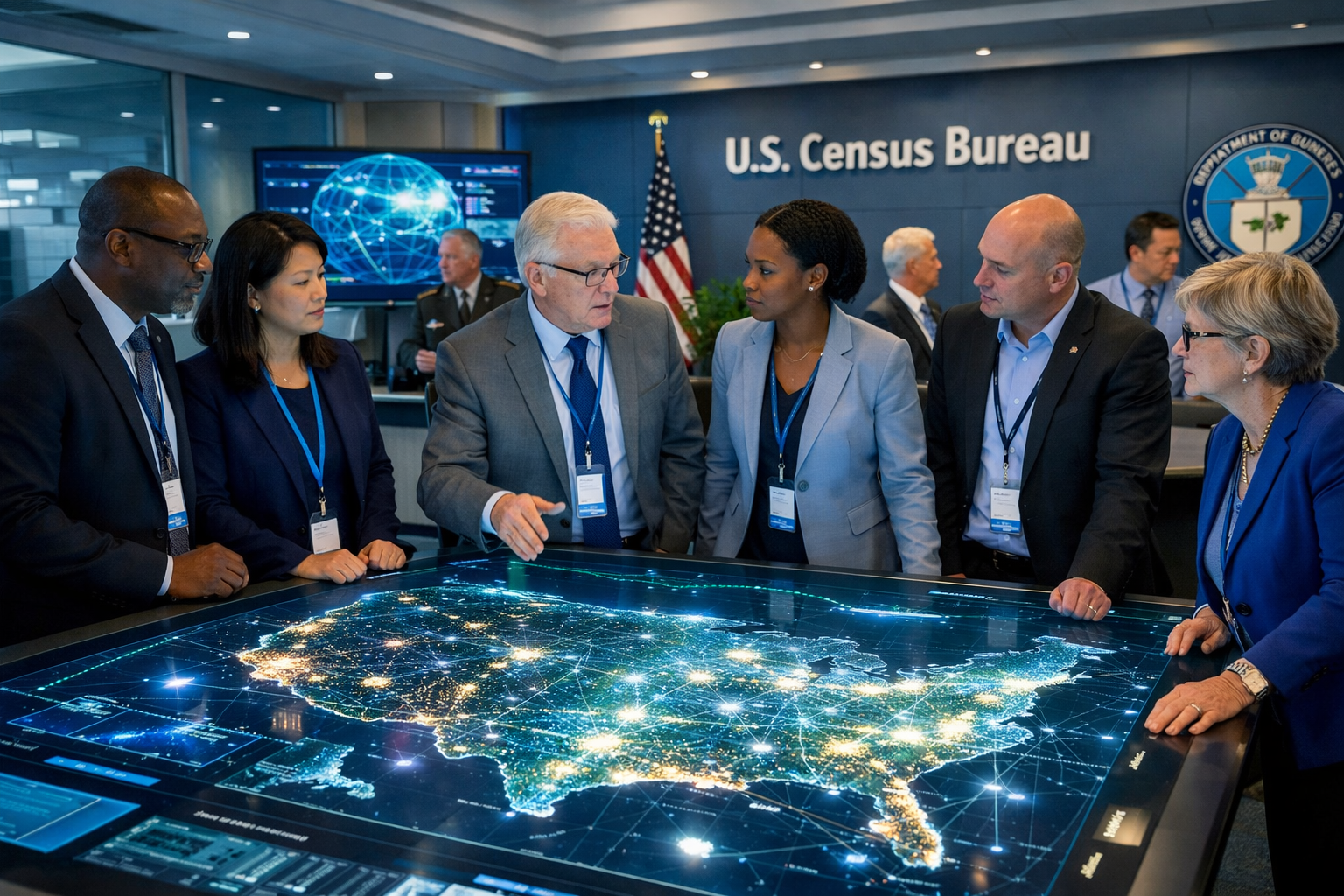
April 22–23, 2026 | U.S. Census Bureau Headquarters, Suitland, MD
Last month, the federal geospatial community convened for FedGeoDay 2026, one of the most important gatherings on the geospatial community calendar. Hosted at the U.S. Census Bureau, this year’s event centered on a timely and critical theme:
“Building Ecosystems for Supporting Federal Data Stewardship.”
For New Light Technologies (NLT), the conference provided an opportunity to both learn from federal leaders and showcase two foundational programs that support the nation’s spatial and socio-economic data infrastructure. We are proud to be an annual sponsor of such an important geospatial gathering!
Why FedGeoDay Matters
FedGeoDay has grown into a premier forum focused on open geospatial ecosystems—bringing together:
- Federal program managers
- Data scientists and engineers
- Open-source developers
- Policy and technology leaders
The conference emphasizes the systems that quietly power government operations:
open data, interoperable platforms, and collaborative infrastructure.
As federal agencies face rapidly expanding data volumes and increasing expectations for transparency, robust data stewardship frameworks are no longer optional—they are mission-critical.
Conference Highlights
- Keynote: Denice Ross (Federation of American Scientists, former U.S. Chief Data Scientist)
- Focus: Resilient data ecosystems and equitable data outcomes
- New Additions:
- First-ever unconference track
- NOAA workshop on the updated National Spatial Reference System (NSRS)
- Expanded plenary sessions and cross-agency discussions
The venue itself—the Census Bureau—reinforced the importance of data as national infrastructure.
NLT Spotlight #1: U-SMART — The Nation’s Positional Backbone
One of the most critical yet often overlooked components of geospatial infrastructure is survey control data.
The U.S. Army Corps of Engineers’ U-SMART platform serves as the authoritative system for:
- Survey monuments and control points
- Geodetic and tidal datums
- NSRS-aligned spatial reference data
This data underpins everything from:
- Flood risk modeling
- Navigation systems
- Infrastructure planning
- Coastal resilience studies
Modernization Impact
NLT worked on transforming U-SMART from a legacy system into a cloud-native platform. The Civil Works Business Intelligence (CWBI) platform is the U.S. Army Corps of Engineers' (USACE) primary, cloud-based Automated Information System (AIS) for integrating, analyzing, and visualizing data across its Civil Works mission.
Key advancements include:
- Serverless microservices architecture → scalable and cost-efficient
- Modern web-based interface → improved usability and visualization
- Offline/online field data capture → supports real-world workflows
- Federated authentication (CAC/PIV) → secure multi-agency access
- Streamlined data governance workflows → improved stewardship
The result is a resilient, accessible, and scalable system that strengthens the foundation of federal geospatial data.
NLT Spotlight #2: Census LEHD — The Nation’s Economic Data Backbone
If U-SMART anchors spatial positioning, the Census Longitudinal Employer-Household Dynamics (LEHD) program anchors economic insight.
LEHD provides the most granular workforce data in the U.S., including:
- Job creation and transitions
- Commuting patterns
- Industry dynamics
- Workforce demographics
Key Data Products
- Quarterly Workforce Indicators (QWI)
- LODES (Origin-Destination Employment Statistics)
- Job-to-Job Flows (J2J)
- Post-Secondary Employment Outcomes (PSEO)
These datasets power decision-making for:
- Federal and state agencies
- Economic development organizations
- Transportation planners
- Researchers and academics
NLT’s Role (20+ Years)
NLT supported LEHD through:
- Data engineering & cloud infrastructure
- DevSecOps and CI/CD pipelines
- Public-facing applications and APIs
- Disclosure Avoidance Systems (privacy protection)
NLT also helped build OnTheMap, an award-winning application recognized with the Department of Commerce Gold Medal.
This work reflects a core challenge in federal data stewardship:
Delivering accurate, timely, and privacy-protected data at scale.
The Bigger Picture: Data Stewardship in the Age of AI
A key takeaway from FedGeoDay 2026:
Federal geospatial data is becoming foundational to the next generation of AI systems.
This raises the stakes for:
- Data quality and integrity
- Interoperability across agencies
- Long-term sustainability of public datasets
- Ethical and secure data use
…are no longer just government systems—they are a national infrastructure for innovation.
Why NLT Continues to Invest in FedGeoDay
FedGeoDay creates a rare environment where:
- Federal agencies collaborate openly
- Industry partners share real implementations
- Industry & Open-source communities contribute directly
- Practical solutions—not just ideas—are discussed
For NLT, it’s an essential forum to:
- Share lessons learned
- Strengthen partnerships
- Stay aligned with federal priorities
- Contribute to the evolution of national data infrastructure
Explore FedGeoDay
About New Light Technologies
New Light Technologies (NLT) is a Washington, DC-based firm with 25+ years of experience delivering:
- Geospatial systems and enterprise GIS
- Cloud-native data platforms
- AI/ML and advanced analytics
- DevSecOps and cybersecurity solutions
NLT supports federal, state, and international organizations in operationalizing data for mission impact.