![[HERO] Fieldwork Without a Signal: A Guide to Building High-Performance Offline Mobile Apps for Disaster Zones](https://cdn.marblism.com/76CrrIFkaOf.webp)
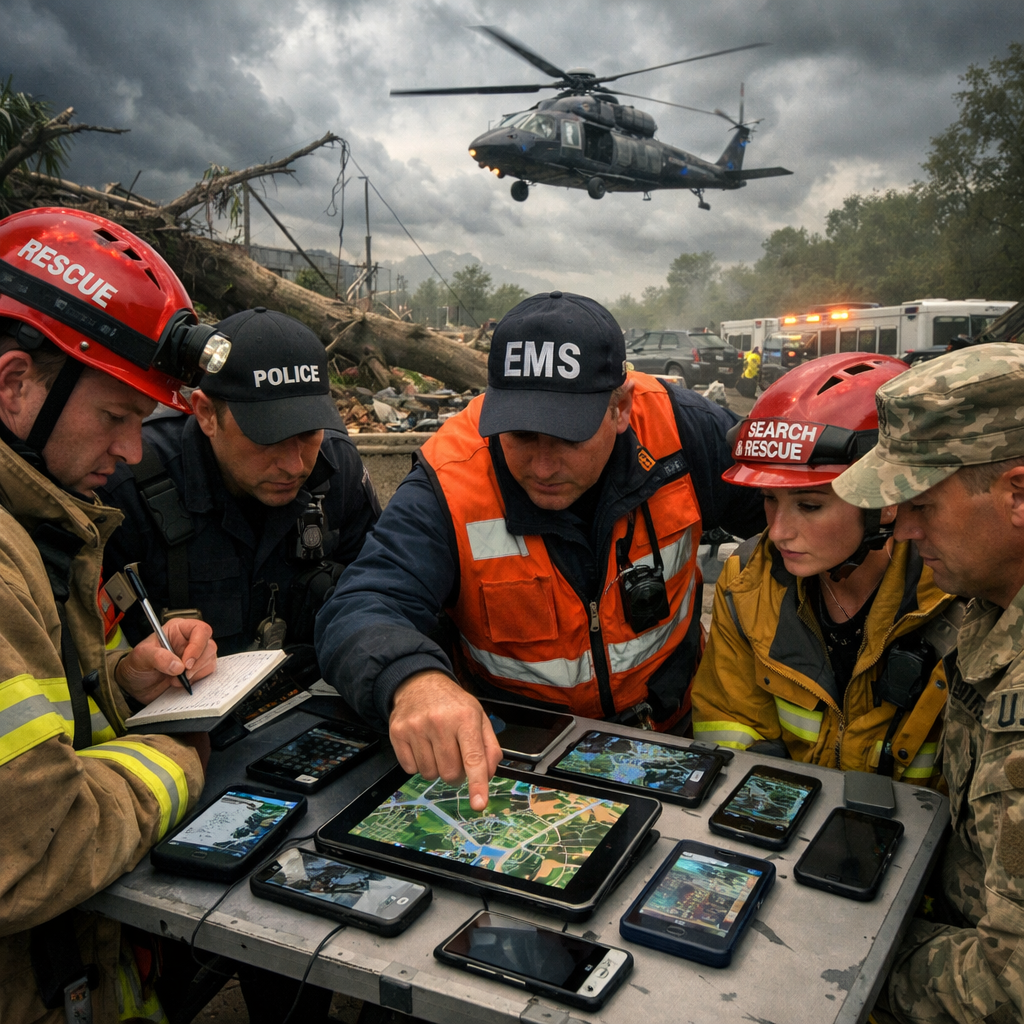
When a hurricane makes landfall, an earthquake ruptures critical infrastructure, or a wildfire sweeps through remote terrain, the cellular networks and internet connectivity that modern society depends upon are often among the first casualties. First responders, emergency managers, and field personnel find themselves operating in environments where the very tools designed to support their mission: smartphones, tablets, and mobile applications: become inoperable precisely when they are needed most. This paradox represents one of the most significant yet underaddressed challenges in contemporary disaster response technology, and it demands a fundamental shift in how organizations approach mobile application architecture for mission-critical environments.
For more than 24 years, New Light Technologies (NLT) has partnered with federal agencies, state and local governments, and non-profit organizations to deliver technology solutions that function reliably under the most demanding conditions; the company's integrated approach, which combines deep expertise in geospatial analytics, remote sensing, cloud infrastructure, and software engineering, positions NLT as a trusted partner for organizations that cannot afford technology failures when lives and communities hang in the balance.
The Case for Offline-First Architecture in Disaster Response
The conventional approach to mobile application development assumes persistent connectivity: applications query remote servers for data, synchronize changes in real time, and depend on cloud infrastructure for core functionality. This paradigm, while efficient for everyday consumer applications, proves catastrophically inadequate in disaster scenarios where cellular towers are damaged, power grids fail, and network congestion renders data transmission unreliable or impossible.
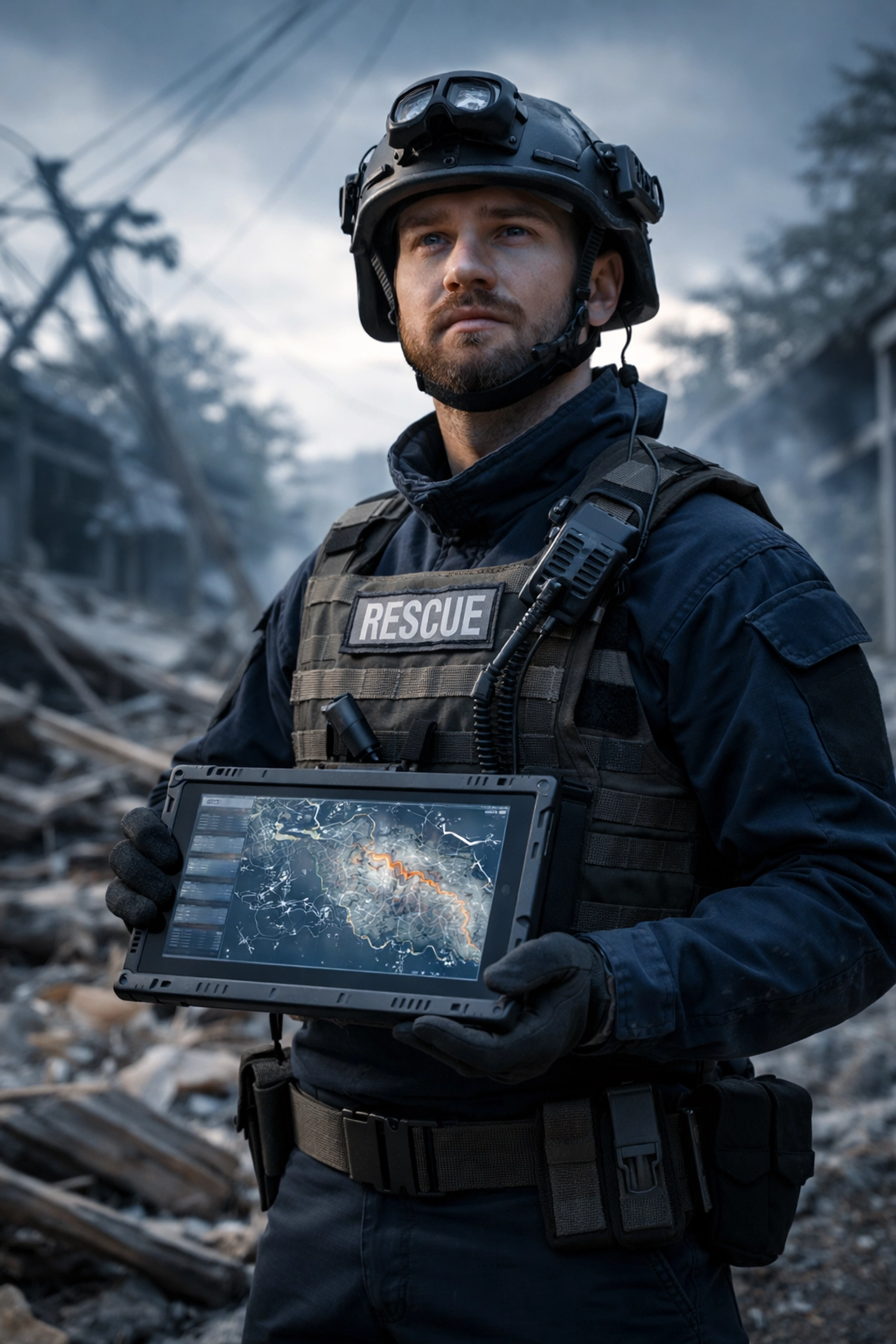
Offline-first architecture inverts this assumption entirely; rather than treating offline capability as a fallback or edge case, offline-first design treats disconnected operation as the primary mode and connectivity as an opportunistic enhancement. This architectural philosophy ensures that field personnel can access critical information, capture incident data, navigate evacuation routes, and coordinate response activities regardless of network availability. Research indicates that mobile applications designed with robust offline capabilities can reduce emergency response times by up to 30 percent, a margin that translates directly into lives saved and communities protected.
The concept of "Synoptic Risk": the interconnected, cascading nature of hazards across systems and geographies: further underscores the importance of offline resilience. When a single event triggers failures across multiple infrastructure domains, responders must operate with the understanding that communications infrastructure may be compromised for extended periods; applications designed without this understanding become liabilities rather than assets in precisely the moments when technology should provide its greatest value.
Technical Considerations for High-Performance Offline Applications
Building mobile applications that perform reliably in disconnected environments requires careful attention to several critical technical domains, each of which presents unique challenges and trade-offs that must be navigated with precision.
Local Data Persistence and Storage Architecture
The foundation of any offline-capable application lies in its approach to local data storage. Applications must pre-download and cache all essential data: including maps, contact directories, standard operating procedures, reference materials, and historical incident data: to device storage before deployment to the field. This requirement demands thoughtful decisions about data formats, compression algorithms, and storage hierarchies that balance completeness against device storage constraints.
SQLite databases, combined with modern object-relational mapping (ORM) frameworks, provide robust local persistence for structured data; meanwhile, tile-based mapping systems allow applications to store detailed geospatial information for entire regions, enabling turn-by-turn navigation and situational awareness even when satellite imagery services are unreachable. NLT's extensive experience in geospatial data management and remote sensing positions the company to architect storage solutions that prioritize the information most critical to field operations while minimizing storage footprint.
Conflict Resolution and Data Synchronization
Perhaps the most technically demanding aspect of offline application development involves the synchronization of data captured during disconnected operation with central systems once connectivity is restored. When multiple field teams operate independently, capturing observations, updating incident status, and modifying shared records without coordination, the potential for conflicting changes grows exponentially.

Effective synchronization strategies must address several key challenges: identifying which local changes should propagate to central systems; detecting and resolving conflicts when multiple users modify the same records; maintaining data integrity across distributed nodes; and ensuring that synchronization processes complete reliably even when connectivity is intermittent or bandwidth-constrained. Conflict-free replicated data types (CRDTs), operational transformation algorithms, and carefully designed merge policies provide the technical foundations for robust synchronization, but their implementation requires deep expertise in distributed systems and a thorough understanding of operational workflows.
NLT's approach to these challenges draws upon the company's experience supporting federal agencies with mission-critical data systems, where data integrity and auditability are non-negotiable requirements. The company's solutions incorporate comprehensive change tracking, automatic conflict detection with human-in-the-loop resolution for ambiguous cases, and bandwidth-efficient delta synchronization that minimizes data transfer requirements when connections are available.
Battery Optimization and Resource Management
Field operations in disaster zones often extend for days or weeks, during which access to reliable power may be severely limited. Applications that drain device batteries through inefficient processing, excessive GPS polling, or poorly optimized rendering become unusable within hours, undermining the entire offline strategy.
High-performance offline applications must implement aggressive power management strategies: batching GPS location captures rather than continuous tracking; using efficient data structures that minimize processing overhead; implementing intelligent caching that reduces redundant computations; and providing users with clear visibility into battery consumption so they can make informed decisions about feature usage. These optimizations require careful profiling and testing under realistic field conditions, not merely laboratory benchmarks.
NLT's Integrated Approach to Mission-Ready Technology
New Light Technologies brings a distinctive combination of capabilities to the challenge of offline mobile application development, one that reflects the company's 24-year history of serving organizations with complex, high-stakes technology requirements. Unlike vendors that specialize narrowly in mobile development or cloud infrastructure, NLT integrates expertise across the full technology stack: from geospatial data acquisition and analysis through software engineering, cybersecurity, and cloud operations: to deliver solutions that address the complete mission context rather than isolated technical components.

This integrated approach proves particularly valuable in disaster response contexts, where the boundaries between technology domains blur and success depends on seamless coordination across systems. NLT's work supporting disaster management initiatives demonstrates the company's ability to deliver technology that performs reliably under pressure, informed by deep understanding of operational realities and mission requirements.
The company's pioneering work in disaster management solutions reflects a commitment to continuous innovation in service of community resilience; over the years, NLT has delivered this type of mission-ready, offline-capable field technology support for the Federal Emergency Management Agency (FEMA) and the U.S. Army Corps of Engineers, helping bridge the signal gap that so often undermines data collection, operational coordination, and cross-team collaboration when connectivity becomes intermittent or unavailable, while partnerships with organizations ranging from FEMA to the World Bank provide NLT with unparalleled insight into the diverse contexts in which disaster response technology must operate.
Building for the Moments That Matter
The true test of any technology solution comes not during routine operations but during moments of crisis, when the gap between capability and requirement becomes starkly visible. Organizations that invest in offline-first mobile architecture position themselves to maintain operational effectiveness precisely when that effectiveness matters most: when communities are vulnerable, when infrastructure is compromised, and when every minute of response time carries consequences measured in human welfare.
For organizations seeking to enhance their disaster response capabilities through technology that remains reliable regardless of connectivity conditions, NLT offers not merely technical expertise but a genuine partnership grounded in shared commitment to mission success. The company's comprehensive solutions portfolio encompasses the full range of capabilities required to design, develop, deploy, and sustain offline-capable mobile applications that meet the demanding requirements of disaster response operations.
To explore how NLT can support your organization's mission-critical mobile technology requirements, visit newlighttechnologies.com or connect with the company's team of experts who understand that when signals fail, technology must not.